Quería escribir hoy sobre mis problemas en el aeropuerto de Malta, cuando mi vuelo sufrió un retraso de ocho horas por la nieve (incluyendo una escala en Stuttgart), y de mi viaje a Starý Smokovec, en las montañas del Alto Tatras en Eslovaquia, pero la huelga salvaje e impresentable de los controladores aéreos españoles se ha colado en mi blog, como en tantos otros. No es la primera vez que escribo sobre el tema y temo que no será la última.
La noticia de esta huelga me sorprendió en Viena, donde estaba pasando la noche esperando a mi vuelo del día siguiente por la mañana. Debo admitir que me costó tiempo asimilar lo que estaba pasando, pues apenas daba crédito a lo que decía el canal de información 24 horas de TVE: abandonar el puesto de trabajo me parece lo último que debe hacer un trabajador. Inmediatamente, la parte irracional e impulsiva de mi cerebro ideó una solución: llevarles a la torre de control a punta de pistola: o trabajo o cárcel (la realidad no ha andado muy lejana, ¿verdad?). Una vez que parece que todo ha pasado y que voy leyendo algunas declaraciones de controlodares, tratando de justificarse, me veo casi obligado a dedicar algunas reflexiones a esta casta de mierda (uff, espero que Blogger no me bloquee el blog por este calificativo algo escatológico, aunque merecido).
La primera es que todos, absolutamente todos, tenemos que asumir que el derecho de huelga no está siempre garantizado: hay trabajos que no pueden hacer huelga por su naturaleza e importancia para la sociedad. Ejemplos de estas profesiones son los médicos, bomberos, policías, soldados y, sí, controladores aéreos. Esto se debe tener claro cuando se decide por una opción profesional de esta lista. Si alguien no está dispuesto a renunciar a su derecho de huelga, puede considerar otras profesiones donde este derecho está plenamente garantizado: basurero, minero, obrero de la construcción o mensajero, entre otras muchas.
Segundo, no creo que trabajar 1600 horas a la semana con generosos descansos entre las jornadas y durante las mismas sea equiparable a condiciones de esclavitud. Quienes trabajan en régimen de esclavitud son, entre otros muchos en el mundo, desafortunadamente, los mineros chinos, los millones de mujeres que son obligadas a prostituirse o los empleados de multinacionales en países como Vietnam o Camboya. Semejante comparación sonroja a quien la escucha y descalifica a quien la hace. Haciendo un cálculo rápido, trabajar 1600 horas en un año, tomando cinco de vacaciones, supone 34 horas a la semana: una cifra muy inferior a las 40 horas que trabajamos el resto de españoles. Nuevamente, si estas condiciones le parecen a alguien inasumibles, pues simplemente se puede dedicar a otra profesión.
Tercero, los controladores aéreos no son los únicos trabajadores que tienen en sus manos la vida de otras personas, así que tampoco entiendo que ésta sea la razón de sus reclamaciones laborales. Los conductores de autobús, los policías o los maquinistas del AVE tampoco cuentan con mucho margen de error si se equivocan en su trabajo. Entiendo que semejante responsabilidad puede ser difícil de llevar mentalmente; aunque, por otra parte, también entiendo que quien no puede vivir con ello, es que no sirve para ese trabajo. Existen opciones en el mercado laboral de profesiones con mucha menor presión. A modo de ejemplo, en una cadena de montaje de una fábrica o en una caja de un supermercado no se toman decisiones de las que depende la vida de nadie, en la mayoría de los casos.
Cuarto, casi ningún país de nuestro entorno sufre estos problemas con sus controladores aéreos. Precisamente la semana pasada leía un artículo sobre los futuros controladores aéreos en Alemania y ninguno cuestionaba las condiciones laborales que conlleva esa profesión: es algo que se acepta y punto. Estados Unidos tuvo un problema similar y Ronald Reagan lo solucionó echando a la calle a todos los controladores y poniendo a militares en su lugar.
Quinto, duele ver a los representantes de su sindicato quejarse de las condiciones laborales y de la mala imagen que tienen en la sociedad (por cierto, todos somos responsables últimos de la imagen que los demás tienen de nosotros, imagen que construimos con nuestros actos y decisiones). Duele aún más con una tasa de desempleo del 20% en España. Duele aún más cuando a los funcionarios públicos les han rebajado el sueldo y cuando muchos otros trabajadores han aceptado rebajas laborales con tal de no perder su trabajo. Además, este sector debe ser el único en el que el sindicato de los trabajadores controla el número de plazas nuevas de controladores que se convocan en España; ¿se imagina alguien que los trabajadores de FASA Renault, por ejemplo, impusieran a la dirección de la compañía el número de trabajadores a contratar el año próximo? Pues eso.
Por último, ver estas imágenes de viajeros tirados en los aeropuertos españoles daña la imagen de nuestro país en el exterior, en una época turbulenta en la que esto es precisamente lo que menos conviene a nuestro país. Demuestra además una tremenda desconsideración por quienes no tienen la oportunidad de viajar muy a menudo (por motivos económicos o laborales) y un inmenso desapego por la realidad del país.
En definitiva, aplaudo la decisión del Gobierno, por una vez, de militarizar el control aéreo español, espero que esta decisión se siga manteniendo en el futuro y desearía que los controladores paguen por lo que han hecho, ya sea económicamente mediante indemnizaciones, con la pérdida de su empleo o con una larga temporada en la cárcel (militar, a ser posible).
¡¡¡Qué asco me dan!!!
Sunday, December 05, 2010

Tuesday, November 30, 2010
Malta under the sun
These days, most of my colleagues were jealous of me since I had a business trip to Malta, implying that I was going to be under the sun at 20ºC and not under the German winter. Although the trip was rather short, I think I managed to get a comprehensive impression of what Malta can offer.
 Firstly, landing there was not easy. I had the idea that Malta is quite a small island so I was getting concerned when I saw our plane flying over Maltese land without much intention to land: I was afraid we were going to land in the ocean! Luckily, nothing like this happened. At the airport, I was surprise to find a Boeing 747, since it seems to be too small for this kind of planes (anyway, as I am not an engineer...).
My hotel stayed close to the sea and also the main gate of La Valetta, Malta's capital. So I just walked five minutes uphill (I was also surprised by the fact that Malta is much more hilly than expected) and I was in front of the gate. There I understand the main nature of the island: La Valetta is really a fortress surrouned by the sea and by impressive city walls. It would be really difficult to siege the place with success. As a consequence, the city is quite small for a capital (around 7000 inhabitants, could it be that?), since there is no more space to build additional dwellings. By the way, the name of the city comes from the general of the Knights of Malta who defended the island against the Turks, back in the sixteenth century.
Malta is quite a religious country and it can be observed in the amount of ch urches in La Valetta and the devotion of the population. Everywhere there are evidences of the important role of religion in the life of the Maltese. As an example of this, I found this nice indulgence in a corner in a small street in Malta. Unfortunately, I do not think I did what was requested in order to gain them... One should not forget that Malta was home to a number of religious orders in the Middle Age. The influence of these orders is still rather strong in the island.
Malta was under British control until it gained its independence in 1964. There are a lot of traces of the British presence in the island. I would like to mention, among others, the mailboxes, the phoneboxes and the fact that they drive on the other side of the road. The surnames, however, are mainly of Italian or Spanish nature (quite familiar to me, anyway) and seem not to have inherited much from the British. My main purpose of the visit was business related, what means that I did not have much time for tourism. It meant that I was busy all Monday morning and then I rushed to the airport, because my plane was leaving at 15:20. I did not know it yet, but it was the beginning of an extraordinary adventure, which took me to Stuttgart airport and which brought me back home at 1:30 in the morning...
 Firstly, landing there was not easy. I had the idea that Malta is quite a small island so I was getting concerned when I saw our plane flying over Maltese land without much intention to land: I was afraid we were going to land in the ocean! Luckily, nothing like this happened. At the airport, I was surprise to find a Boeing 747, since it seems to be too small for this kind of planes (anyway, as I am not an engineer...).
My hotel stayed close to the sea and also the main gate of La Valetta, Malta's capital. So I just walked five minutes uphill (I was also surprised by the fact that Malta is much more hilly than expected) and I was in front of the gate. There I understand the main nature of the island: La Valetta is really a fortress surrouned by the sea and by impressive city walls. It would be really difficult to siege the place with success. As a consequence, the city is quite small for a capital (around 7000 inhabitants, could it be that?), since there is no more space to build additional dwellings. By the way, the name of the city comes from the general of the Knights of Malta who defended the island against the Turks, back in the sixteenth century.
Malta is quite a religious country and it can be observed in the amount of ch
 urches in La Valetta and the devotion of the population. Everywhere there are evidences of the important role of religion in the life of the Maltese. As an example of this, I found this nice indulgence in a corner in a small street in Malta. Unfortunately, I do not think I did what was requested in order to gain them... One should not forget that Malta was home to a number of religious orders in the Middle Age. The influence of these orders is still rather strong in the island.
Malta was under British control until it gained its independence in 1964. There are a lot of traces of the British presence in the island. I would like to mention, among others, the mailboxes, the phoneboxes and the fact that they drive on the other side of the road. The surnames, however, are mainly of Italian or Spanish nature (quite familiar to me, anyway) and seem not to have inherited much from the British.
 My main purpose of the visit was business related, what means that I did not have much time for tourism. It meant that I was busy all Monday morning and then I rushed to the airport, because my plane was leaving at 15:20. I did not know it yet, but it was the beginning of an extraordinary adventure, which took me to Stuttgart airport and which brought me back home at 1:30 in the morning...
Friday, November 26, 2010
Un jour à Bratislava
Il y a quelques jours je suis allé à Bratislava pour une présentation dans la Banque Nationale Slovaque (Národná Banka Slovenska ou NBS). En total, je suis resté dans la Slovaquie environ 24 heures mais ce sont certes choses que je voudrais souligner.
 D'abord, Bratislava n'a pas d'aérport international; il faut aller à Vienne et puis prendre un bus ou un taxi pour Bratislava. Ce sont seulement 6o kilomètres, mais un taxi autrichien normal coût 100 euros. Puis, mon conseil est de le prenoter avant de partir: on peut épagrner environ 30 euros.
Une fois arrivés à l'hôtel, l'endroit était plein des slovaques qui celebraient le jour de la chute du communisme (il y a quelques ans). Dans l'hôtel même, il y avait une soirée de gala et le hall était plein de gardes du corps, hommes importants et femmes jeunes avec petites robes. Mais les restaurantes autour du centre ville étaient vides, vraiment vides: personne n'était là. La raison pour ce lè reste un mystère.
Pour conclure, le siège du Národná Banka Slovenska se trouve dans un bâtiment neuf de verre. La vue panoramique de 28ème ètage est impresionnante. Néanmois, à côté de ce beau bâtiment, on trouve la Radio Slovaque: un bâtiment en forme de pyramide inversée qui nous montre le pire de l'architecture. Il est aussi affreux qui ne mérite pas une photo.
Et bon, ce que j'ai fait dans ma première fois à Bratislava. Cette semaine je vais de nouveau: que avrai-je à racconter après?
 D'abord, Bratislava n'a pas d'aérport international; il faut aller à Vienne et puis prendre un bus ou un taxi pour Bratislava. Ce sont seulement 6o kilomètres, mais un taxi autrichien normal coût 100 euros. Puis, mon conseil est de le prenoter avant de partir: on peut épagrner environ 30 euros.
Une fois arrivés à l'hôtel, l'endroit était plein des slovaques qui celebraient le jour de la chute du communisme (il y a quelques ans). Dans l'hôtel même, il y avait une soirée de gala et le hall était plein de gardes du corps, hommes importants et femmes jeunes avec petites robes. Mais les restaurantes autour du centre ville étaient vides, vraiment vides: personne n'était là. La raison pour ce lè reste un mystère.
Pour conclure, le siège du Národná Banka Slovenska se trouve dans un bâtiment neuf de verre. La vue panoramique de 28ème ètage est impresionnante. Néanmois, à côté de ce beau bâtiment, on trouve la Radio Slovaque: un bâtiment en forme de pyramide inversée qui nous montre le pire de l'architecture. Il est aussi affreux qui ne mérite pas une photo.
Et bon, ce que j'ai fait dans ma première fois à Bratislava. Cette semaine je vais de nouveau: que avrai-je à racconter après?
Sunday, November 21, 2010
A rainy weekend in Paris
 Last weekend, I went with my parents, by train, to Paris: our first opportunity to know the French capital, one of the top cities in Europe. The date (mid-November) was quite risky and we were not disappointed by the weather Paris had reserved for us: during one and a half day, it was raining cats and dogs, sometimes together with strong winds. An umbrella was broken and it was not until we bought a second one that it stopped raining. If we had not bought that umbrella, it could still be raining now! In despite of that (and of the just nice hotel room), Paris is always a nice place to visit.
As we were staying also on Monday, we decided to go upstairs the Eiffel Tower then. Unfortunately, the summit was closed due to some reparation works in the elevators, so I could not feel what I have watched in films like Superman II or A View to Kill. Anyhow, the second level is enough to give the visitor a broad perspective of Paris, from a monster of iron, built more than 100 years ago by a genious.
While visiting Arc du Triomphe, my mother insisted in going upstairs as well, so amidst rain and wind, we spent some time
 on top of it, with breathtaking views of Champs Elysées. There we had quite a strange experience the previous day, since people were entering shops like Louis Voutton or Toyota like crazy, apparently completely unawere of the goods' prices. This part of Paris is well-known in my family thanks to Tour de France and it was somehow special for the three of us to walk through places so many times watched on TV. Going back to Arc du Triomphe, it can also be considered as a Geography test, since it is really challenging placing all the battles won by Napoleon (some of them in Spain and even in Guadalajara): you can try it with the picture to the right.
Another remarkable site of Paris is Notre Dame. I was surprised that the entrance was free (not like in Sainte Chapelle), so we also went inside. The cathedral is quite dark inside, inviting everybody to think and pray and not to take many pictures. Sacre Coeur, in Montmatre, is a church with much more light, although it seems also too much oriented towards tourism. Notre Dame seems still to keep its real function: being a place of pray. Regarding the construction itself, it is one of the key gothic cathedrals in Europe (see picture below):
 I have mentioned some of the top tourist hubs in Paris, but Paris does not end there. Centre Pompidou, Louvre, Dôme des Invalides, Pont Alexander III, Montmatre, Saint Sulspice, Place des Vosgues,... are places which are worth a visit and which have the power to always open the visitor's mouth. The most relaxing time of our stay happened seated in a fountain in the Tuilleires, enjoying some minutes of sun, with a nice view of Quay d'Orsay. Below is the evidence of this moment:
Tuesday, November 16, 2010
¿Quién tiene realmente el poder?
Antes de escribir sobre mi anterior fin de semana y sobre mi excursión de 24 horas a Bratislava (al antiguo bloque comunista, achtung!), quería dejar una reflexión sobre las diferentes iniciativas que se han llevado a cabo internacionalmente para mitigar o prevenir los efectos de la actual crisis financiera.
Por una parte, se han impuesto medidas descomunales a algunos Estados para reducir su innegable deajuste presupuestario. Para implantar estas medidas no se ha podido perder tiempo y, de este modo, se han diseñado planes de ajuste draconianos en países como España, Irlanda, Grecia o Reino Unido: los mercados y el mundo no podían esperar. Estos ajustes recaen sobre la población de estos países que poco o nada ha tenido que ver con la crisis.
Por el contrario, los bancos, aquellos a los que todo el mundo ha señalado como origen y catalizadores de la crisis, ganan tiempo tras cada reunión del G20 para implantar medidas dirigidas a incrementar el control sobre ellos y a fortalecer sus balances. Para realizar estos ajustes siempre hay tiempo en el futuro, siempre se encuentra una razón por la que es mejor no hacerlo ahora.
Comparando estas dos diferentes varas de medir y viendo quién tiene que realizar ajustes "a la voz de ya", no puedo evitar preguntarme quién tiene realmente el poder en el mundo.
Por una parte, se han impuesto medidas descomunales a algunos Estados para reducir su innegable deajuste presupuestario. Para implantar estas medidas no se ha podido perder tiempo y, de este modo, se han diseñado planes de ajuste draconianos en países como España, Irlanda, Grecia o Reino Unido: los mercados y el mundo no podían esperar. Estos ajustes recaen sobre la población de estos países que poco o nada ha tenido que ver con la crisis.
Por el contrario, los bancos, aquellos a los que todo el mundo ha señalado como origen y catalizadores de la crisis, ganan tiempo tras cada reunión del G20 para implantar medidas dirigidas a incrementar el control sobre ellos y a fortalecer sus balances. Para realizar estos ajustes siempre hay tiempo en el futuro, siempre se encuentra una razón por la que es mejor no hacerlo ahora.
Comparando estas dos diferentes varas de medir y viendo quién tiene que realizar ajustes "a la voz de ya", no puedo evitar preguntarme quién tiene realmente el poder en el mundo.
Monday, November 08, 2010
A city in decadence
As I already suggested, indirectly, in the last post, Venice is a city in decadence: the visitor can easily experience this after a short time in the city. Beyond the typical view all of us have (gondolas, canals, bridges, churches,...), it is crystal clear that the best years of the city are gone and it seems that it just moves slowly towards its end (do not forget that Venice is facing increasing problems with the high waters, much more often now than before).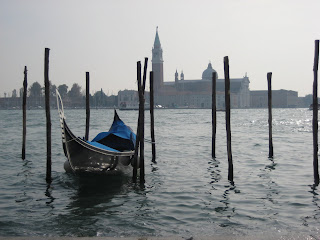 If there is something that Venice has, it is churches. Every square there, except two (according to my guide), has a church. But over all of them I must mention San Marco. It is definitively a different church, much influenced by byzantine architecture. For example, it is not crucifix-shaped and its walls and ceilings are full of colourful mosaics, two features that I had never seen in any other church before.
The best views from Piazza di San Marco are those from the island in front of it (San Giorgio), as you can see in the picture below.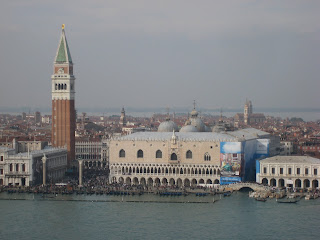 Venice is composed of several islands, the two main of them
 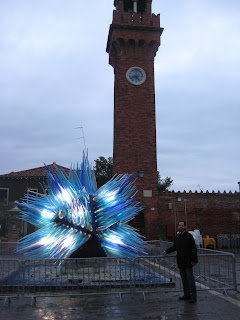 staying around the Canal Grande. But there are many others, being Murano probably the most remarkable. Murano is known for its glass factories. In my case, I was lucky when I arrived as to watch a demonstration of how glass is made and then I could access the exclusive part of the factory's shop, with masterpieces whose price was beyond 45.000 €. It was quite a remarkable experience, much like being in a museum.
Another remakable place to visit in Venice is the Jewish Ghetto. The word ghetto was actually taken from here. The island where the Jews lived in Venice was closed during the nights, so that nobody could leave or enter into it. For this reason, the highest buildings of Venice are to be found here, with six or seven floors (quite an interesting number for buildings from XVI century).
One of the places more crowded with tourists is the "Bridge of sights". Contrary to what many think, it has nothing to do with love. It was the bridge joining the court with the jail and the sighs where those coming from the people going into jail, when they saw Venice for the last time in a long time. It should not be forgotten that Venice built its power, among other sources, from its own "Black legend". But the Dux was not exercising an absolute power, but, on the contrary, his powers were rather limited, when compared with similar rulers in Europe, since there were a number of assemblies and boards governing the city. Regarding the picture below, Venice was quite good at sailing, but its maps were maybe not so accurate: the ocean you see is the Pacific Ocean, between California and China.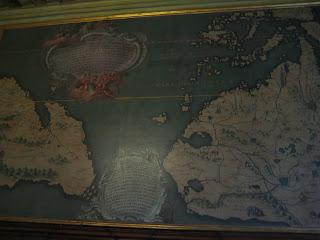 Anyway, I do not want to bore you. Visiting Venice is a must for everybody, for its history, for its beauty and for everything.
 If there is something that Venice has, it is churches. Every square there, except two (according to my guide), has a church. But over all of them I must mention San Marco. It is definitively a different church, much influenced by byzantine architecture. For example, it is not crucifix-shaped and its walls and ceilings are full of colourful mosaics, two features that I had never seen in any other church before.
The best views from Piazza di San Marco are those from the island in front of it (San Giorgio), as you can see in the picture below.
 Venice is composed of several islands, the two main of them
  staying around the Canal Grande. But there are many others, being Murano probably the most remarkable. Murano is known for its glass factories. In my case, I was lucky when I arrived as to watch a demonstration of how glass is made and then I could access the exclusive part of the factory's shop, with masterpieces whose price was beyond 45.000 €. It was quite a remarkable experience, much like being in a museum.
Another remakable place to visit in Venice is the Jewish Ghetto. The word ghetto was actually taken from here. The island where the Jews lived in Venice was closed during the nights, so that nobody could leave or enter into it. For this reason, the highest buildings of Venice are to be found here, with six or seven floors (quite an interesting number for buildings from XVI century).
One of the places more crowded with tourists is the "Bridge of sights". Contrary to what many think, it has nothing to do with love. It was the bridge joining the court with the jail and the sighs where those coming from the people going into jail, when they saw Venice for the last time in a long time. It should not be forgotten that Venice built its power, among other sources, from its own "Black legend". But the Dux was not exercising an absolute power, but, on the contrary, his powers were rather limited, when compared with similar rulers in Europe, since there were a number of assemblies and boards governing the city. Regarding the picture below, Venice was quite good at sailing, but its maps were maybe not so accurate: the ocean you see is the Pacific Ocean, between California and China.
 Anyway, I do not want to bore you. Visiting Venice is a must for everybody, for its history, for its beauty and for everything.
Thursday, November 04, 2010
Llegando a Venecia
El fin de semana pasado estuve por primera vez en Venecia. Realmente ha sido una visita fascinante: se puede apreciar la importancia de Venecia en épocas pasadas y se respira historia por todos sus poros y canales. Sin embargo, antes de pisar suelo italiano, vi en el aeropuerto de Fráncfort el nuevo Airbus A380, siendo remolcado por una de las pistas (ahora que está de actualidad). Realmente no se acaba de apreciar lo enorme que es el avión, pues no hay nada con que compararlo. Basta con mirar el tamaño de los motores para darse cuenta de que es realmente grande.
 La llegada a Venecia fue bastante plácida, más allá de ver cómo el recién estrenado puente de Calatrava es el único que está siendo reforzado... Resulta curioso a primera vista ver cómo todo el transporte público funciona con barcos (el equivalente a lo que en otras ciudades son los autobuses o los taxis).
Realmente por cosas como esta, Venecia es una ciudad diferente. En el siguiente post, me explayaré sobre el tema.
 Sin embargo, antes de pisar suelo italiano, vi en el aeropuerto de Fráncfort el nuevo Airbus A380, siendo remolcado por una de las pistas (ahora que está de actualidad). Realmente no se acaba de apreciar lo enorme que es el avión, pues no hay nada con que compararlo. Basta con mirar el tamaño de los motores para darse cuenta de que es realmente grande.
 La llegada a Venecia fue bastante plácida, más allá de ver cómo el recién estrenado puente de Calatrava es el único que está siendo reforzado... Resulta curioso a primera vista ver cómo todo el transporte público funciona con barcos (el equivalente a lo que en otras ciudades son los autobuses o los taxis).
Realmente por cosas como esta, Venecia es una ciudad diferente. En el siguiente post, me explayaré sobre el tema.
Subscribe to:
Posts (Atom)