Ayer leí el discurso que pronunció Andrew Haldane, Director de Estabilidad Financiera del Banco de Inglaterra, en la conferencia anual de Jackson Hole (la misma a la que Mario Draghi no pudo acudir por tener demasiado trabajo). El discurso, en inglés, está disponible en http://www.bankofengland.co.uk/publications/Documents/speeches/2012/speech596.pdf. En líneas generales, los discursos de Andrew Haldane son realmente preciosos, con una clarividencia que no es frecuente en estos tiempos.
En este caso, si bien no estoy muy de acuerdo con la fábula del perro y del frisbee, el resto del texto me parece sencillamente brillante. En él, Andrew Haldane hace una feroz crítica de la creciente complejidad de la regulación financiera, que tampoco está trayendo resultados mucho mejores que anteriores versiones más fáciles de entender. El ejemplo de las normas de Basilea de solvencia de los bancos es sangrante: en su primera versión, se pedía que el capital del banco fuera al menos el 8% de sus activos; mientras que en sucesivas revisiones y versiones, el acuerdo ha ido creciendo en número de páginas (ya está por encima de las 1000) y en complejidad (ahora se hace referencia a los activos ponderados por el riesgo, modelos internos,...).
Otro tanto sirve con el envío de información a los reguladores y supervisores. En lugar de centrarse en la información básica hay una tendencia hacia recibir información muy granular, a nivel de transacción, dando lugar a un fenómeno parecido al de Internet: la inmensa cantidad de información disponible acaba por no tener ningún valor por sobrepasar la capacidad humana de analizarla. No se acaba de entender que en este caso la cantidad de información no importa, sino que es la calidad.
Otra referencia de Andrew Haldane en su discurso comprende los modelos económicos y financieros, donde se queja de su complejidad, poniendo de manifiesto la enorme cantidad de estimaciones que llevan implícitos (basten como ejemplos las ponderaciones de los riesgos en Basilea II o el famoso VAR). Otros modelos, por el contrario, se dedican a demostrar lo obvio (con poco valor añadido para la sociedad, por tanto) o realizan tales asunciones iniciales que pierden todo su vínculo con la realidad. En este caso, ciertamente, parece más sensato mirar a una serie de indicadores básicos que a buen seguro nos van a dar información muy valiosa sobre lo que está sucediendo. Si uno observa el crecimiento del crédito inmobiliario en España en los últimos años, a partir de las tablas del Boletín Estadístico del Banco de España, se encuentra con tasas de crecimiento del 20%. No hace falta ser un gurú para darse cuenta de que semejante ritmo de crecimiento no puede ser sostenible a largo plazo. Sin embargo, por motivos quizá de vanidad intelectual y similares, este tipo de indicadores no son lo suficientemente "sexys" en este momento.
A modo de conclusión, se podría decir que ya es el mundo suficientemente complejo de por sí, como para que andemos nosotros añadiendo complejidad innecesaria a él. Y es que, a fin de cuentas, la economía son habas contadas...
Thursday, September 06, 2012

Sunday, September 02, 2012
Deux films entre Francfort et Madrid
Mercredì soir, je suis allé à Madrid avec Lan et aujourd'hui je suis retourné à Francfort. Avec Lan on a divertissement à bord, parce que le trajet entre Francfort et Madrid (et vice-versa) fait parti d'un trajet intercontinentale (Santiago de Chili-Madrid-Francfort). Si on est méticuleux, on peux voir un film complete en chaque trajet. Après deux ans et demi à Francfort, on peut dire que j'ai appris cette connaissance.
Dans le première trajet, j'ai regardé le film australien "The hunter", avec Willem Defoe et Sam Neill (http://en.wikipedia.org/wiki/The_Hunter_%282011_Australian_film%29). Ici Willem Defoe est un chasseur professionnel qui cherche le disparu tigre de Tasmanie, en travaillant pour une société de biologie, qui cherche l'ADN du tigre. Le voyage du chausseur change sa perception du monde et lui devient un défenseur de la nature. Ce film ne changerà pas la histoire de cinéma, mais il est très facile et agréable de digérer.

Aujourd'hui, dans le trajet entre Madrid et Francfort, j'ai regardé le film "Green zone", avec Matt Damon (http://en.wikipedia.org/wiki/Green_Zone_%28film%29). Ici, Matt Damon est un soldat américain en cherchant des ADM (Armes de Destruction Massive) et de la verité en Iraq. Situé en 2003, dans les premières semaines d'occupation en Bagdad, le film n'est pas facile à assimiler, il est un racconte réaliste de la cronique caché de l'invasion américaine de l'Iraq, avec tous ses erreurs et abuses. Matt Damon se demanda oú sont les ADM, qui sont la raison pour laquelle il est en guerre dans l'autre côté du monde, et découvre une manipulation de son propre gouvernement.
"Green zone" est vraiment un film politique, mais au milieu d'une guerre représentée avec toute réalisme et cruauté, qui nous montre un des épisodes plus tristes et honteux du XXIème siècle. Il s'agit d'un film qui nous montre un soldat qui ne tue comment un machine, mais qui se fait la question clé: pourquoi tue-t-il?
Dans le première trajet, j'ai regardé le film australien "The hunter", avec Willem Defoe et Sam Neill (http://en.wikipedia.org/wiki/The_Hunter_%282011_Australian_film%29). Ici Willem Defoe est un chasseur professionnel qui cherche le disparu tigre de Tasmanie, en travaillant pour une société de biologie, qui cherche l'ADN du tigre. Le voyage du chausseur change sa perception du monde et lui devient un défenseur de la nature. Ce film ne changerà pas la histoire de cinéma, mais il est très facile et agréable de digérer.
Aujourd'hui, dans le trajet entre Madrid et Francfort, j'ai regardé le film "Green zone", avec Matt Damon (http://en.wikipedia.org/wiki/Green_Zone_%28film%29). Ici, Matt Damon est un soldat américain en cherchant des ADM (Armes de Destruction Massive) et de la verité en Iraq. Situé en 2003, dans les premières semaines d'occupation en Bagdad, le film n'est pas facile à assimiler, il est un racconte réaliste de la cronique caché de l'invasion américaine de l'Iraq, avec tous ses erreurs et abuses. Matt Damon se demanda oú sont les ADM, qui sont la raison pour laquelle il est en guerre dans l'autre côté du monde, et découvre une manipulation de son propre gouvernement.
"Green zone" est vraiment un film politique, mais au milieu d'une guerre représentée avec toute réalisme et cruauté, qui nous montre un des épisodes plus tristes et honteux du XXIème siècle. Il s'agit d'un film qui nous montre un soldat qui ne tue comment un machine, mais qui se fait la question clé: pourquoi tue-t-il?
Tuesday, August 28, 2012
Ein gutes Buch für Sommer
Heute möchte ich über das letzte Buch, das ich im Sommer gelesen habe, schreiben. Von nächste Woche ab sollte ich mit die Bücher über mein Studium von Englische Literatur anfangen. Das Buch heisst "El imperio eres tú" auf Spanisch (etwas wie "Das Reich bist du" auf Deutsch), ist von Javier Moro geschrieben und hat den Planeta Preis 2011 gewonnen.
Es handelt sich um das Leben von Peter I, erste Kaiser von Brasilien in XIX. Jahrhundert (http://de.wikipedia.org/wiki/Peter_I._%28Brasilien%29). Das Buch beginnt mit das Kind Peter, das seit kurz in Brasilien wohnt, weil sein Vater, König von Portugal, dort ins Exil von Portugal nach Brasilien gefahren ist. Man entdeckt schnell, dass Peter ein Mensch zwischen zweit Welte ist: die alte Welt den Königen, dargestellt bei die Königin Catarina, und die neue Ideen aus der Französische Revolution.
Das Buch präsentiert den Kaiser wie ein Mensch, der viel erleidet und der weit von perfekt ist. Es ist einen interessanten Text über Jahren, die unsere Welt definierten und die Leidenschaften, die Peters Benehmen führte. Peter I hatte ein kurzes Leben aber er hatte Zeit, um Portugiese und Brasilianer zu sein, aber immer mit das Gefülh sich Fremden in beiden Staaten zu sein.
Javier Moro hat ein anderes Buch über Brasilien geschrieben: "Senderos de libertad", wo er das Leben von Chico Mendes erzählt. Es sieht es aus, dass Javier Moro ein besonderes Talent oder Sensibilität für Brasilien hat.
Es handelt sich um das Leben von Peter I, erste Kaiser von Brasilien in XIX. Jahrhundert (http://de.wikipedia.org/wiki/Peter_I._%28Brasilien%29). Das Buch beginnt mit das Kind Peter, das seit kurz in Brasilien wohnt, weil sein Vater, König von Portugal, dort ins Exil von Portugal nach Brasilien gefahren ist. Man entdeckt schnell, dass Peter ein Mensch zwischen zweit Welte ist: die alte Welt den Königen, dargestellt bei die Königin Catarina, und die neue Ideen aus der Französische Revolution.
Das Buch präsentiert den Kaiser wie ein Mensch, der viel erleidet und der weit von perfekt ist. Es ist einen interessanten Text über Jahren, die unsere Welt definierten und die Leidenschaften, die Peters Benehmen führte. Peter I hatte ein kurzes Leben aber er hatte Zeit, um Portugiese und Brasilianer zu sein, aber immer mit das Gefülh sich Fremden in beiden Staaten zu sein.
Javier Moro hat ein anderes Buch über Brasilien geschrieben: "Senderos de libertad", wo er das Leben von Chico Mendes erzählt. Es sieht es aus, dass Javier Moro ein besonderes Talent oder Sensibilität für Brasilien hat.
Tuesday, August 21, 2012
In the country of the spiders
Last weekend, I was travelling through Belgium to attend the baptism of my godchild Leandro in Mechelen. As I am living in Frankfurt, there were no planes involved in this trip, something which I certainly liked.
 So, the trip took me first from Frankfurt to Liège by train. Then I took a second train to Charleroi and from there a bus to Mechelen. In total I think it is a trip of less than 200 kilometres but which gave me a good overview of Belgium.
Liége, and the cities which I saw on the train to Charleroi, has the air of an old and dark city. The train station, designed by Santiago Calatrava, does not change the opinion of the traveller when arriving there. It is a nice building, full of light, but when you look beyond, you only see old brick houses, derelict industrial areas and grey sky. The same may be applied to Charleroi, but multiplied by five (at least). Uff, one feel there that this is an industrial city, where coal and steel have been the drivers of it in the past 200 years.
 One positive aspect of this part of the trip was to see the huge river Mose, which I have never heard of, and which is certainly impressive. Being a Spaniard not used to big rivers, it seems I am easily seduced by any big river I see.
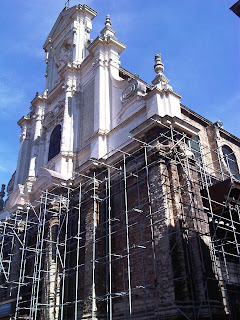 Mechelen, on the contrary, a city I know quite well and where we spent three days, has the atmosphere of a quiet and interesting town. This time I have discovered important aspects of its history, like the "beguinage" (http://en.wikipedia.org/wiki/Beguinage) or its past history as capital of the Low Countries. The city centre has been recently renovated and it is delightful to walk there.
Finally, what most surprised me in the trip was the amount of spiders I have seen in three days. Everywhere, in every corner of Belgium, there was a spider web, with the spider hanging around it. I am not particularly scared of spiders (this honor is for snakes) but I cannot understand it: in Spain spiders are not so common and spider webs are quickly cleaned out when found in the streets or in houses. It seems that Belgium is a more "spider-friendly" country...

Liége, and the cities which I saw on the train to Charleroi, has the air of an old and dark city. The train station, designed by Santiago Calatrava, does not change the opinion of the traveller when arriving there. It is a nice building, full of light, but when you look beyond, you only see old brick houses, derelict industrial areas and grey sky. The same may be applied to Charleroi, but multiplied by five (at least). Uff, one feel there that this is an industrial city, where coal and steel have been the drivers of it in the past 200 years.

 Mechelen, on the contrary, a city I know quite well and where we spent three days, has the atmosphere of a quiet and interesting town. This time I have discovered important aspects of its history, like the "beguinage" (http://en.wikipedia.org/wiki/Beguinage) or its past history as capital of the Low Countries. The city centre has been recently renovated and it is delightful to walk there.
Finally, what most surprised me in the trip was the amount of spiders I have seen in three days. Everywhere, in every corner of Belgium, there was a spider web, with the spider hanging around it. I am not particularly scared of spiders (this honor is for snakes) but I cannot understand it: in Spain spiders are not so common and spider webs are quickly cleaned out when found in the streets or in houses. It seems that Belgium is a more "spider-friendly" country...
Tuesday, August 14, 2012
Unknown Toledo
It happens sometimes that when you are living abroad (like in Germany), you appreciate much more minor historical cities, which are nothing when compared with some of the wonders we have in Spain. Something like this has happened to me with Toledo (and I am not talking about the Toledo in Ohio).
 Toledo has been for most of my life a place when we were going year after year on holidays with the school, in an age where I was not able to appreciate any historical value at all. I only remember the Alcázar (Toledo's castle), but very vaguely.
 Some days ago, we visited Toledo; in my case for the first time in more than 20 years. In despite of the hot temperatures which accompanied us during our stay (it was like breathing fire, nothing I have seen before), I can say that it was a very interesting visit. The amount of historical buildings (especially churches and convents) is simply breathtaking. What is more, the special configuration of the city, on a hill over River Tagus provides marvellous panoramic views. It is really difficult to highlight something in particular, since the historical center of Toledo is so large and rich in history, that other "historical" towns look like toys compared with it. For example, the picture to the right depicts some paintings in a church from the XIVth century.
The city is announcing itself now to the tourists as the city of the three cultures, since Jews, Muslims and Catholics lived there, in relative harmony, for some hundreds of years. One can question whether life was like that but what I cannot question is that in the some town you can visit a synagogue, a (former) mosque and a church, something which not many places in the world can offer.
Also remarkable are the paintings of El Greco, overall the "Burial of the Count of Orgaz" (http://en.wikipedia.org/wiki/The_Burial_of_the_Count_of_Orgaz), since they seem to be 300 years ahead of the time when they were painted.
 One has to mention here the cathedral, which is really impressive, for the rich collection of art which is inside. I did not like the tone of the music in the audio-guides: it was too similar to some songs from the Spanish Civial War. But, anyway, we forgive it: everybody knows that Toledo is a very religious and conservative city in Spain.
I am just uploading some pictures I took with the Blackberry (because I took my photo camera empty of batteries with no charger), just to give you an idea of what to find there. It is simply too much to put in a single post here, I could write and write and write... The better thing is to walk through the streets of Toledo and to feel the history blowing in the wind.


The city is announcing itself now to the tourists as the city of the three cultures, since Jews, Muslims and Catholics lived there, in relative harmony, for some hundreds of years. One can question whether life was like that but what I cannot question is that in the some town you can visit a synagogue, a (former) mosque and a church, something which not many places in the world can offer.
Also remarkable are the paintings of El Greco, overall the "Burial of the Count of Orgaz" (http://en.wikipedia.org/wiki/The_Burial_of_the_Count_of_Orgaz), since they seem to be 300 years ahead of the time when they were painted.

I am just uploading some pictures I took with the Blackberry (because I took my photo camera empty of batteries with no charger), just to give you an idea of what to find there. It is simply too much to put in a single post here, I could write and write and write... The better thing is to walk through the streets of Toledo and to feel the history blowing in the wind.
Sunday, August 12, 2012
La revolution de Batman
Hier j'ai vu le dernier film de Batman "The dark night rises" et je voulais écrire aujourd'hui sur le contexte politique du film, qui va un peu au-delà de ce que les typiques films de super-héros font.
À la fois des intrigues avec le super-héro, "The dark knight rises" racconte aussi comment une revolution / dictature est née. Tout commence avec des gouttes de démagogie, avec une aggressivité parfois exag et avec la definition de l'ennemi, qui est coupable de tous les problèmes du peuple et qui rejoindre le peuple contre lui. Avec cet ennemi, tout est permis: tribunals que ont dejá trouvé les accusées coupables, cruauté infini, persécution des autres sans raison,... Mais, on a aussi une élite hyper-protégée derrière un pouvoir militair extraordinaire. Le seul pouvoir est ce des armes. Avec ces ingrédients, Gotham ressemble parfois une ville controlée par les seigneurs de la guerre (Mogadiscio?). On trouve cet un peu familier, vrai?
Je vourrais aussi me demander ici sur la motivation de Bane et amis pour détruire Gotham. Ils n'ont pas une raision economique pour ça, il semble d'être seulement pour porter des souffrances au peuple. Ils sont un peu comment le mal gratuit, que je ne le peux pas complètement croire. Peut-être que je suis optimiste, mais ce mal ne se trouve pas dans les humains.
Pour conclure, "The dark knight rises" n'est seulement un film de super-héros très divertissant, mais aussi un film que peux nous fair réfléchir à le cours notre societé suit.
Je vourrais aussi me demander ici sur la motivation de Bane et amis pour détruire Gotham. Ils n'ont pas une raision economique pour ça, il semble d'être seulement pour porter des souffrances au peuple. Ils sont un peu comment le mal gratuit, que je ne le peux pas complètement croire. Peut-être que je suis optimiste, mais ce mal ne se trouve pas dans les humains.
Pour conclure, "The dark knight rises" n'est seulement un film de super-héros très divertissant, mais aussi un film que peux nous fair réfléchir à le cours notre societé suit.
Thursday, August 09, 2012
Bryan Adams in Bratislava
As start of our holiday break in August, we went to the concert of Bryan Adams in Bratislava, on 28th July. Bryan Adams may have not been the number one rock singer in the last thirty years but he really have a collection of good songs, many more than other groups with better reputation and name. I have uploaded here a video of "Everything I do, I do it for you", a tremendous ballad, but certainly not the only remarkable song by Bryan Adams ("Cloud #9", "Summer of 69", "Can't stop this thing we started", "18 till I die" and many others).
Anyway, several things took my attention from the concert. First, the price of the tickets was unusually high for a country like Slovakia, where salaries are not very generous. That probably made that the arena was not full to receive Bryan Adams. In addition to that, the behaviour of the public was very civilised (almost cold) in some parts of the concert.
Concerning Bryan Adams himself, I must say that he looked much older than he really is. He has had difficult years and now little remains of his former face. Having said that, he was very passionate during the concert, which was more than two hours long. Probably, he knows he is taking part in his last big concert tour of his life, so he is trying to leave a good impression everywhere he goes.
In any case, it was a really good concert by a rocker I really like a lot (although my preferences are now in a different domain).
Anyway, several things took my attention from the concert. First, the price of the tickets was unusually high for a country like Slovakia, where salaries are not very generous. That probably made that the arena was not full to receive Bryan Adams. In addition to that, the behaviour of the public was very civilised (almost cold) in some parts of the concert.
In any case, it was a really good concert by a rocker I really like a lot (although my preferences are now in a different domain).
Subscribe to:
Posts (Atom)